
By 1688, if you wanted to insure a ship, you went to a coffee house.
Edward Lloyd’s establishment stood on Tower Street, close enough to the London docks that the river came in with the customers. Lloyd sold coffee, but his real product was information. He gathered the movements of ships (which had sailed, which had arrived, which were overdue), the names of the captains and the ports they were bound for, and had it chalked up and read aloud to the merchants, shipowners and sea captains who filled his tables. In 1691 the business moved to 16 Lombard Street, nearer the centre of the City. By 1734 the shipping news he collected had become a printed sheet, Lloyd’s List, which is published to this day.
A merchant sitting in that room faced a hard problem. He wanted to send a cargo across the Atlantic on a ship he did not own, captained by a man he had never met, along a route where a storm or a privateer could end the venture without warning. If the ship went down, he was ruined. There was no bureau to consult, no trustworthy registry of a captain’s past voyages, no way to establish from a table in London whether the vessel now leaving Bristol was sound.
What the coffee house actually solved
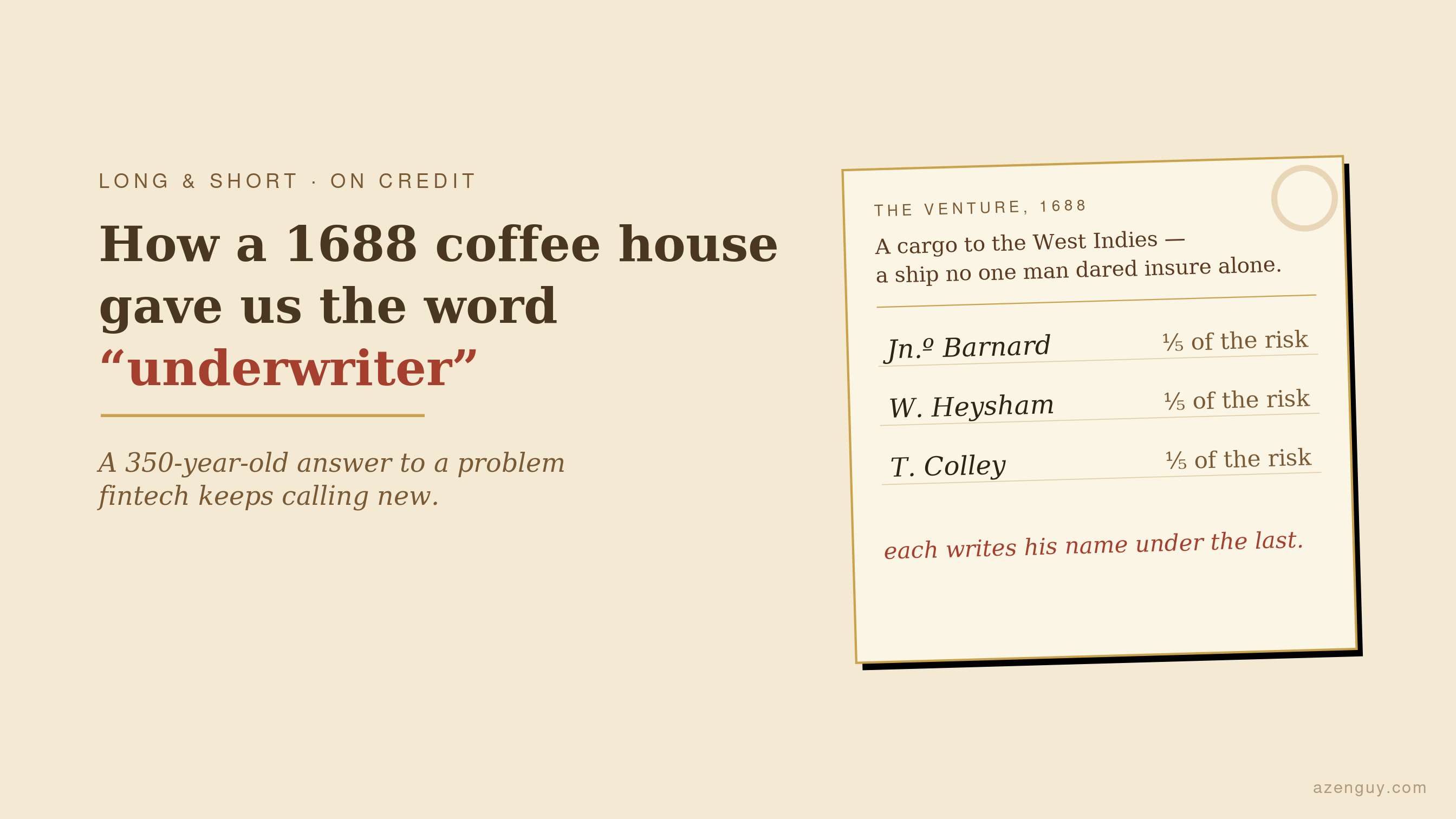
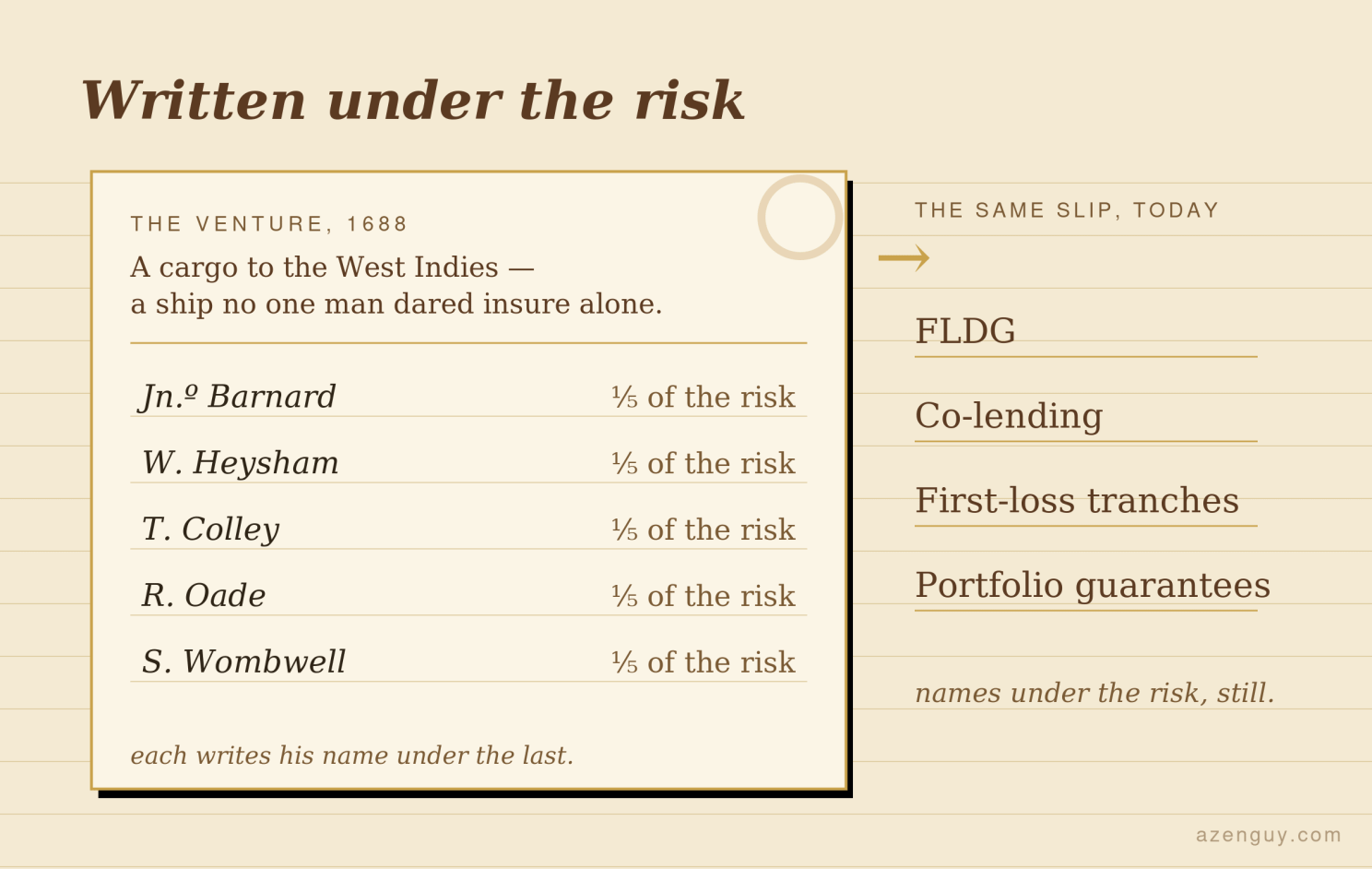
The room worked out something stranger than an answer: a way to live with not knowing. When a voyage needed cover, its details were written on a slip and passed around the tables. A man willing to carry part of the risk in exchange for part of the premium wrote his name beneath the venture, and the share he was prepared to lose. The slip moved on, and the next man wrote his name under the first, and the next under him, until the whole was covered. A single catastrophe that would have destroyed any one of them was divided into portions each could absorb. The men doing this were, quite literally, writing under the risk. We still call them underwriters.
Notice what they had and had not done. They had not found a way to know the captain, the ship, or the weather. They had found a way to be wrong about all three and still open for business the next morning. The innovation at Lloyd’s was the affordability of being wrong.
India’s tryst with trust and risk
Lloyd’s problem is now ours, turned around.
India spent the last decade attacking the half of the problem the coffee house could never touch: verification. We built some of the most elaborate machinery on earth for checking strangers — identity through Aadhaar, income through bank statements, presence through an OTP, the face through video KYC, permission through the Account Aggregator.
Each layer drove the cost of one proof toward zero, and each time it did, a fresh band of strangers became reachable. That was real, and it worked.
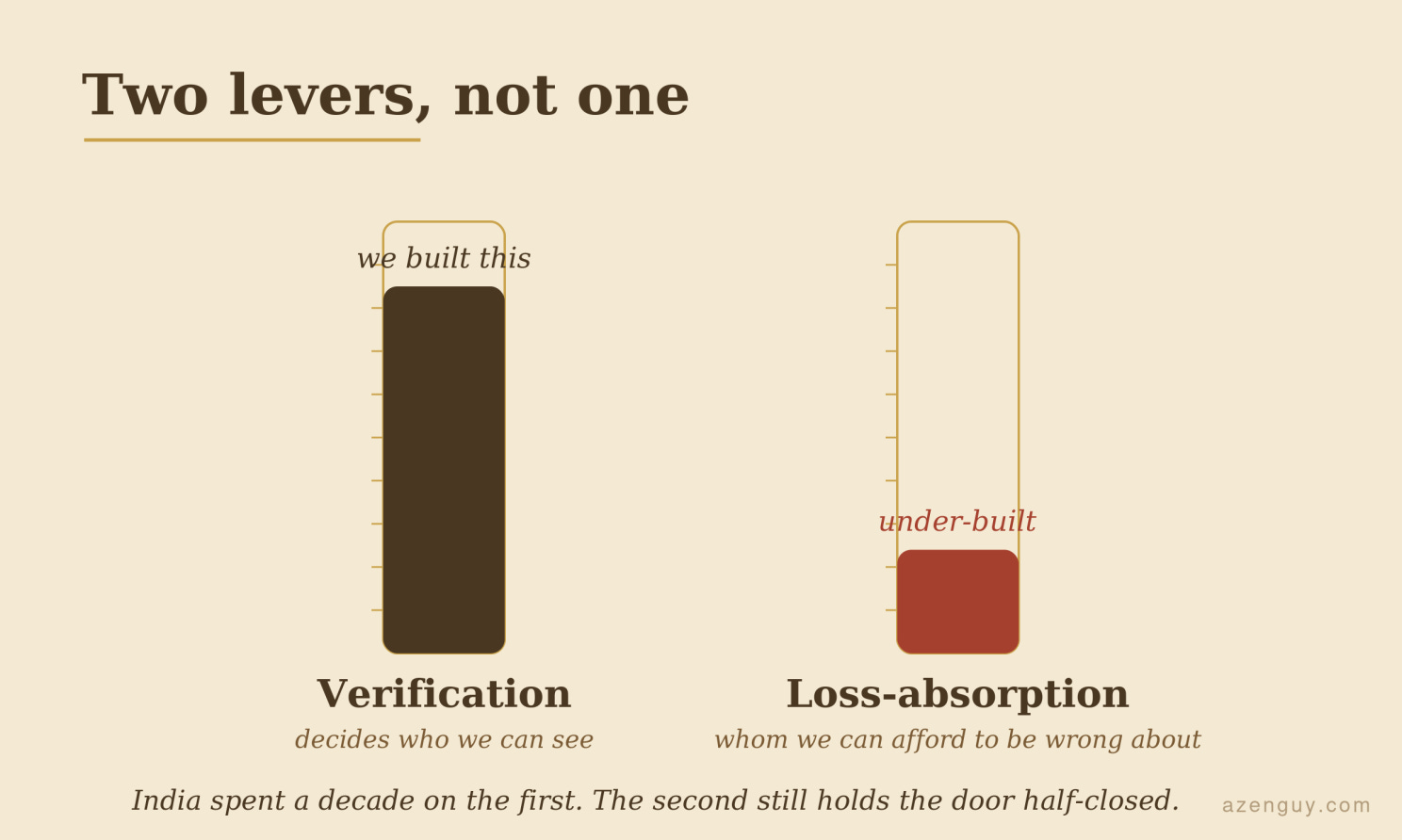
But verifying a stranger and being able to afford a mistake about him are two different capabilities, built by two different levers, and we have leaned almost entirely on the first.
Verification decides who we can see. It says nothing about whom we can survive being wrong about. Those turn out to be separate questions, and for the borrower with no clean paperwork, they pull in opposite directions.
Whose failure can we afford?
Consider who is still shut out after a decade of cheaper proof: the migrant whose address never matches the database, the shopkeeper whose income arrives in cash, the first-time borrower with no history to check. We usually file their exclusion under verification, telling ourselves the system cannot see them clearly enough.
But often the system can see them well enough to lend a small amount. What is missing is anyone who can afford to be wrong about them in bulk. The door is open; the room behind it is small, because no single lender can carry a whole book of first losses on people it has never lent to before.
This is the lever India has under-built: the modern version of names written under the risk.
It even has the instruments. FLDG — the first-loss default guarantee the RBI argued over for years — is a slip passed around a table, a way of writing down, in the open, who absorbs the first portion of the loss. Co-lending is the same instinct: two balance sheets under one voyage. Portfolio guarantees, blended capital, first-loss tranches seeded by development finance: each is a way of making error survivable for the borrower nobody can yet verify. Read this way, FLDG did something the side letters it replaced never had to: it forced the first-loss into daylight and priced it. That is the coffee house move.
Where the parallel cracks
There is a catch the underwriters at Lloyd’s were fortunate to escape, and it is exactly where the parallel breaks. Marine risks are mostly independent — one ship lost in the Atlantic tells you almost nothing about another in the Indian Ocean, so pooling works precisely because the losses do not arrive together.
Credit risk is less obliging. A failed monsoon, a wave of layoffs or a policy shock lands on thousands of thin-file borrowers at once, and a pool that looked deep in an ordinary month is emptied in a single correlated season.
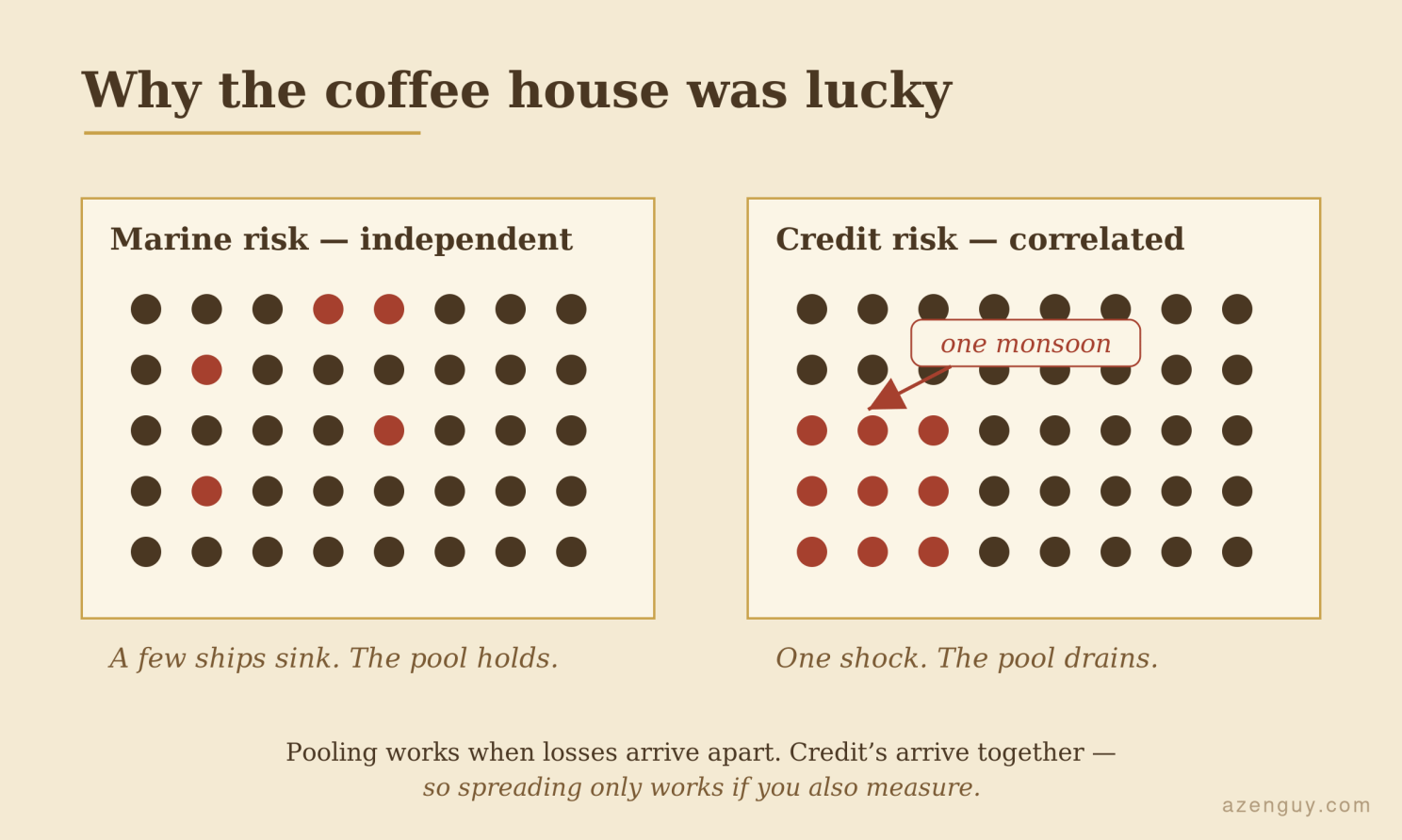
Loss-absorption without measurement is just a bigger bet. So the two levers are substitutes in ordinary weather and complements in a storm: you spread the everyday losses, and you measure well enough to see the rare season when everyone fails at the same time.
Which is the amendment worth making to the story we have been telling ourselves. We said the work of the last decade was driving the cost of verification toward zero, and it was.
But verification only ever decided who we could see. It was loss-absorption that decided whom we could afford to be wrong about, and for the borrower with no history, that second number is the one still holding the door half-closed. The frontier was never a clearer view of the stranger. It was a cheaper price for being wrong about him.