
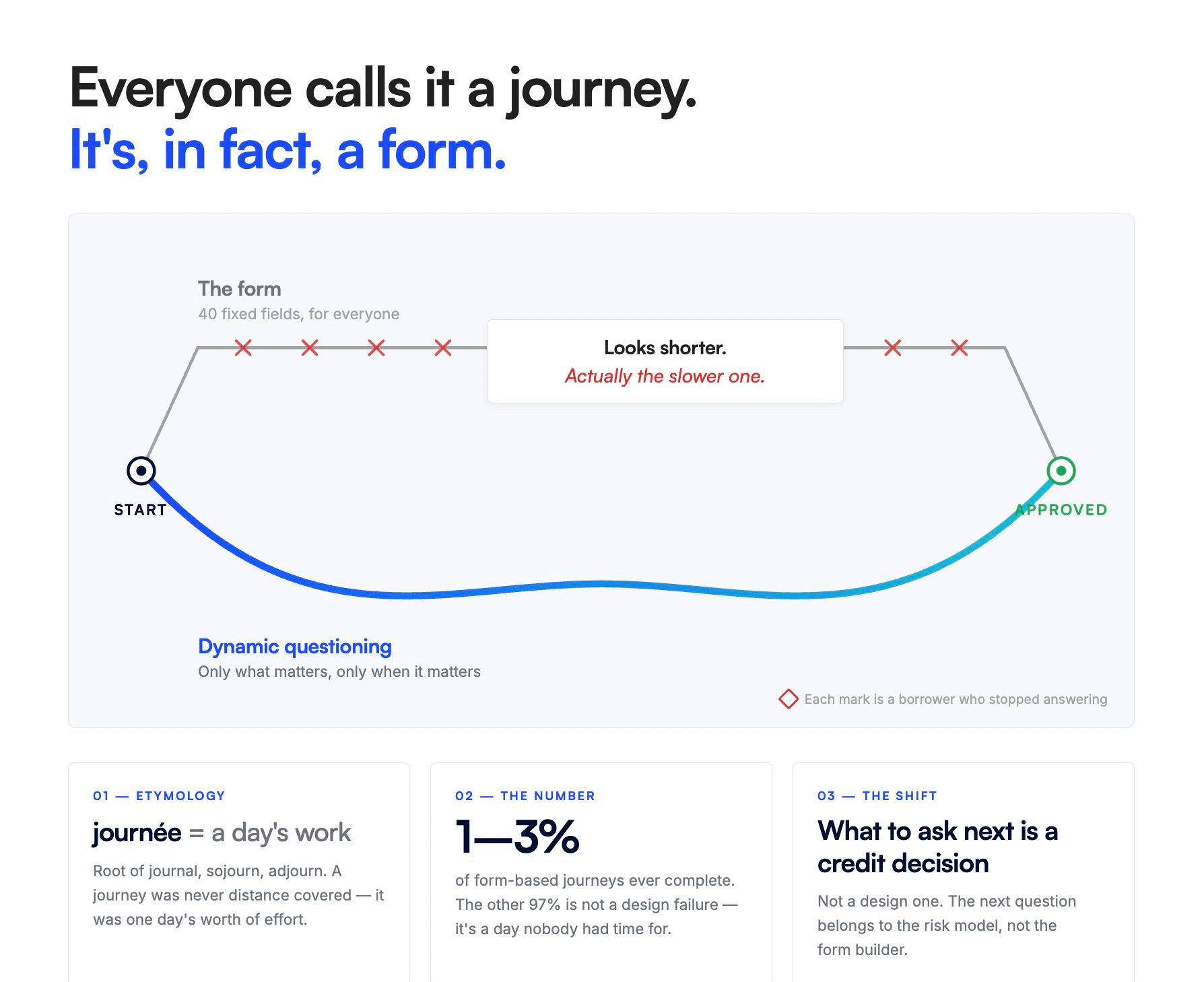
Somewhere along the way, we decided that every form was a "journey."
Onboarding journey, user journey, customer journey. We took the most mechanical thing we build, a list of fields to fill in, and dressed it in the language of travel and adventure.
So I looked up where the word actually comes from. It has nothing to do with roads, or distance, or adventure.
"Journey" is from the Old French journee, a day's work. From the Latin diurnum, a day's portion. The same root as journal, sojourn, adjourn. For most of its life the word had nothing to do with the path at all. A journey was simply how much you could get done in a single day. A unit of effort. A unit of time.
Which makes the borrowed grandeur a little funny, because everyone in lending lives inside this word. The loan journey. The onboarding journey.
And for a decade the craft has been smoothing the road — cleaner forms, fewer taps, one less screen. We polished the path. The word was pointing at the day: the effort, the thirty-odd days a file used to take.
Then it gets stranger. The industry is now killing the form itself, handing over from fixed fields to engines that ask each borrower only what matters to them. On the surface that looks like wandering. A different route every time.
But a river wanders for a reason. The curve is the efficient line, water reading the terrain instead of fighting it.
The fixed form was the straight line: clean on a map but brutal on the ground and hardest on the borrower it fit the least.
So the word was right all along. A journey was never the road. It was the day's worth of effort you spent getting somewhere. Kill the form, and you don't lose the journey. You finally give it back to what it always meant.
P.S. This is roughly the idea behind something we ended up building at FinBox. But the etymology is the part that stays with me.